





Soil is a living system that directly influences crop growth and input requirements, making soil health a grower’s most valuable asset.
At the heart of that system is the soil microbiome: a diverse community of fungi, bacteria, and other microorganisms that drive nutrient transformations and influence nearly every aspect of soil function. A soil’s ability to raise a profitable crop is contingent on the strength of this biological engine. Without a functional engine, nutrients remain locked away in organic matter and are unavailable to the plant.
When Soil Nutrients Are Present but Out of Reach
Soil organic matter (SOM) typically comes from plant- or animal-based residues and serves as both the food source and habitat of the microbiome. Growers consistently focus on building or maintaining SOM as it serves as a reservoir of plant nutrients that can be made available by soil microbiology and is a driver behind water-holding capacity, infiltration, aeration, and aggregation.
Most soils contain substantial reserves of nutrients tied up in residues and organic matter that plants cannot access due to their large molecular sizes or poor solubility. Microbial processing breaks these large nutrient-containing molecules into smaller, plant-accessible nutrient forms.
When SOM is lost to erosion, tillage, or demands of intensive crop production, the biological machinery needed to unlock those nutrients is lost with it. Plant growth-promoting microorganisms become critical under these circumstances. When activated with soil health solutions like Tidal Grow® Oceanic® and Tidal Grow® SeaPhos®, these microorganisms accelerate nutrient breakdown, enhance nutrient use efficiency, and lessen input requirements in a tight farm economy.
Boost Soil Biology with Real Results
Growers don’t necessarily need dramatic changes in farming practices to see improvements in soil health. Instead, small gains in soil biology can continue to pay off over time, ushering in opportunities for more efficient nutrient use, reduced input waste, and more productive crops. Fertilizers that encourage the activity of beneficial bacteria and fungi can help growers cut input costs.
Oceanic® and SeaPhos® promote soil biology functionality in many ways. Made from upcycled seafood byproducts, these hydrolysate liquid fertilizers build soil quality and kickstart plant performance by providing a high-quality feed for the soil microbiome, creating a surge of nutrient cycling and plant-microbe interactions.
But don’t just take our word for it! Oceanic® and SeaPhos® have been put to the test in over 2,000 acres of grower and small plot trials. The results of these field trials show that these alternative fertilizers increase biological activity in relation to key nutrient cycles that directly benefit crop growth.
In a cotton trial that took place in southeastern Texas, Oceanic® applied in-furrow improved microbial populations in the root zone associated with three key nutrient cycles:
- Global Carbon Cycle
Carbon transformations are the currency of a thriving microbial community. With Oceanic® scoring 18 points higher than the control, dramatic improvements in carbon cycling indicate a shift in the microbial community toward carbon accumulation, which, over time, leads to improved nutrient and water-holding capacity.
- Nitrogen Cycle
Nitrogen cycling reflects the soil’s ability to transform nitrogen via microbial processing. With a score of 69 compared to the control’s score of 54, Oceanic® promotes microbial populations that create a steady supply of bioavailable nitrogen. - Global Phosphorus Cycle
Phosphorus fuels metabolic processes, cell division, and root formation in plants, yet it is often deficient in plants due to dysfunctional microbial populations in the soil, among other factors. Oceanic® acts as a stimulant for functional phosphorus cyclers in the soil, resulting in more robust root growth and greater yield potential.
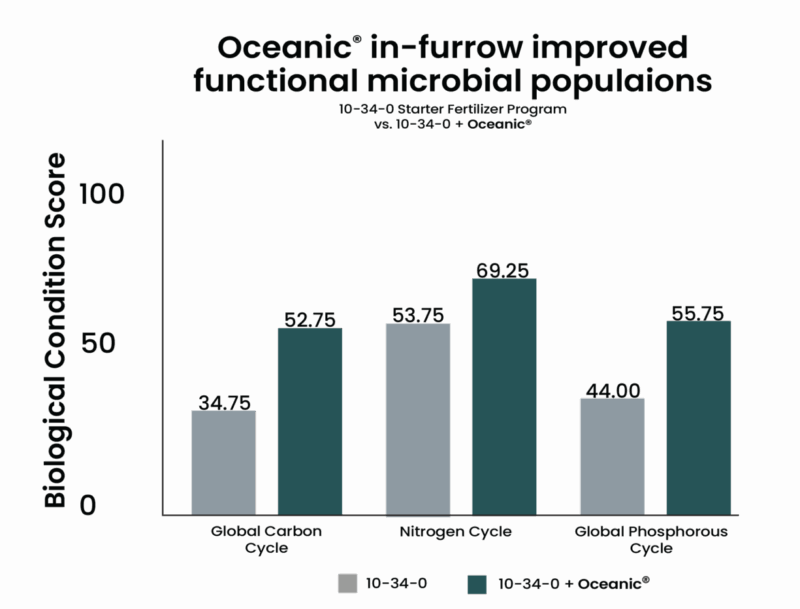
Southeastern Texas. Oceanic® applied at 2 gallons per acre in-furrow resulted in notable improvements in nutrient cycling soil biomarkers 10 days after application. Test: BiomeMakers BeCrop Test.
These improvements in soil microbial populations with Oceanic® led to remarkable improvements in crop productivity of almost 200 lb. lint/ac.
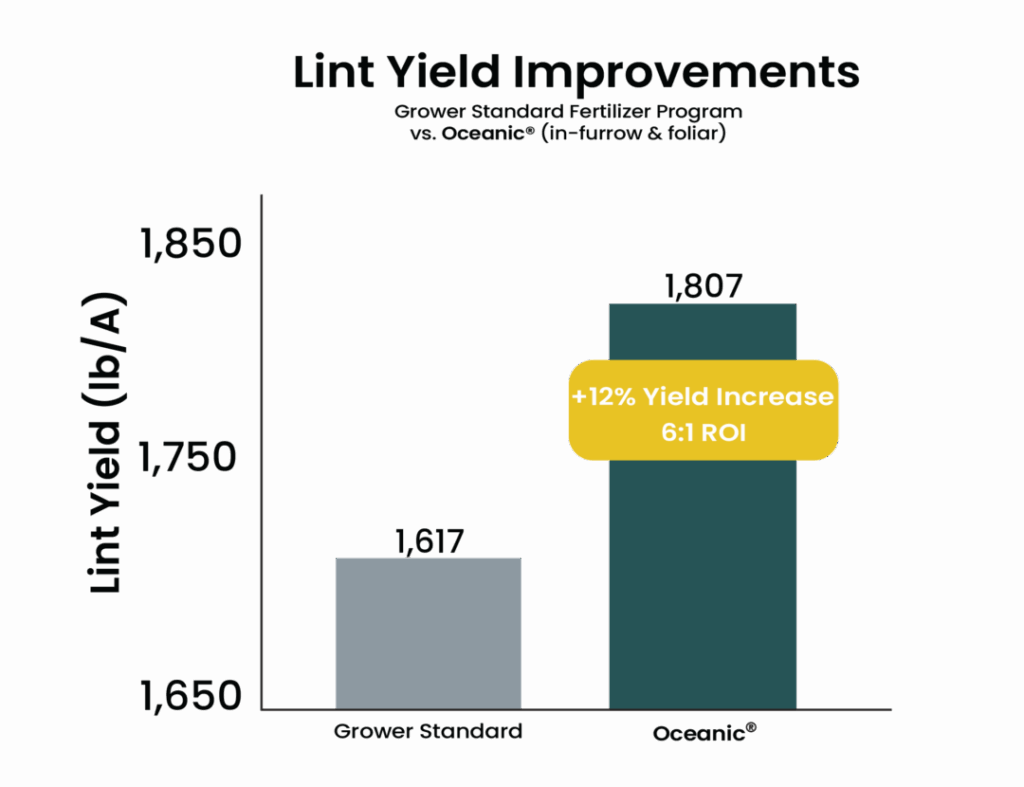
Waller, Texas. In-furrow and foliar-applied Oceanic® at 2 gallons per acre resulted in significant improvements in lint yield in this cotton trial.
In a similar trial in the Texas panhandle, we investigated whether adding Oceanic® to 10-34-0, a common starter fertilizer, improved soil health indicators and corn yield compared to 10-34-0 as a standalone. To investigate soil health, we utilized the Solvita® CO2-Burst test, a soil microbial activity metric that strongly correlates with microbial biomass and nitrogen mobilization.
Notably, 10-34-0 as a standalone reduced soil microbial activity from pre-plant to 10 days after application. Including Oceanic® to 10-34-0 buffered the antimicrobial effects of this formulation and stimulated microbial activity by nearly 40 percent compared to the control. Once again, these improvements in soil health with Oceanic® resulted in stronger yield performance and greater profitability.
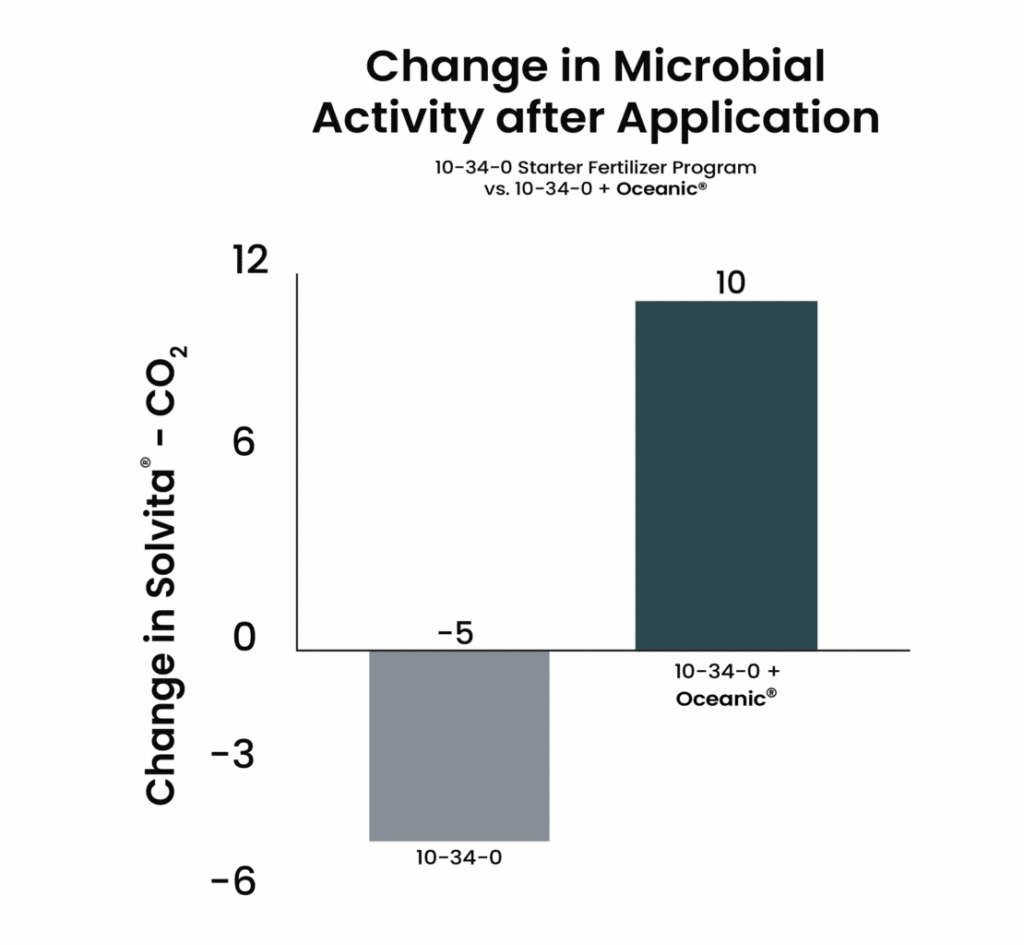
Dumas, TX. Change in Solvita CO2 burst, microbial activity, from pre-plant to 10 days after application in corn.
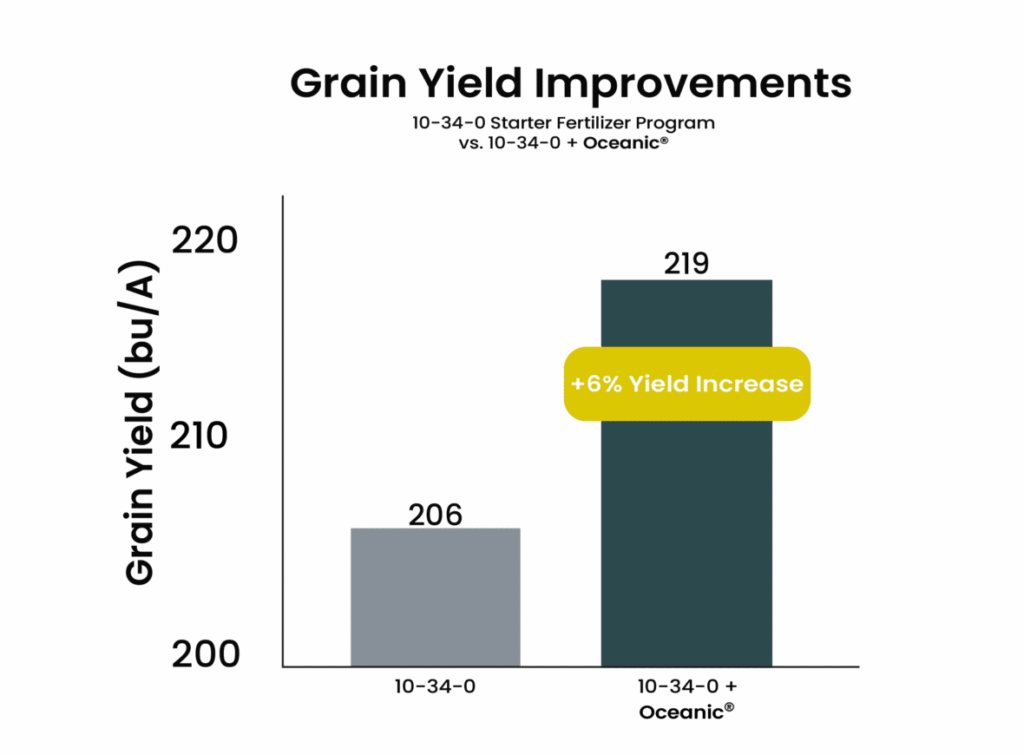
Dumas, Texas. In-furrow and foliar-applied Oceanic® at 2 gallons per acre resulted in significant improvements in grain yield in this corn trial.
Energize Soil Microbes, Unlock Nutrients, and Grow Stronger Crops With Oceanic®
Precisely engineered, cold-processed seafood hydrolysate fertilizers rich in amino acids and omega fatty acids, Oceanic® and SeaPhos® fuel the microbes that drive agronomic efficiencies. The macro-nutritional profile of Oceanic® not only supports nitrogen and phosphorus availability but encourages colonization of residues when sprayed as a post-harvest spray for more rapid decomposition and nutrient release, addressing early-season nutrient stress and better planting/emergence conditions.
As an industry, we’ve spent decades (and centuries in some cases) building soil nutrient reserves in our soils. Rather than just continuing to oversupply fertilizer inputs, one key to healthier, more resilient crops is working with the soil biology to unlock nutrients already present. By supporting microbial activity and promoting efficient nutrient cycling, growers can make the most of these reserves and sustain soil and crop productivity in the short- and long-term.
Ready to Cast a Line for Better Soil Health?
To attract beneficial biology and improve nutrient availability, apply Oceanic® or SeaPhos® during the growing season or use the biofertilizer Oceanic® post-harvest to supercharge residue breakdown, setting your fields up for success come spring.
When growers are working with soil that has thriving biology, their crops follow suit. Connect with a Tidal Grow® AgriScience sales rep today to learn more about how Tidal Grow® Oceanic® and Tidal Grow® SeaPhos® can promote healthier soils, healthier crops, and more profitable operations.
Citations
Prasad, M., Chaudhary, M., Choudhary, M., Kumar, T.K., Jat, L.K. (2017). Rhizosphere Microorganisms Towards Soil Sustainability and Nutrient Acquisition. In: Meena, V., Mishra, P., Bisht, J., Pattanayak, A. (eds) Agriculturally Important Microbes for Sustainable Agriculture . Springer, Singapore. https://doi.org/10.1007/978-981-10-5589-8_2
Inui Kishi, R.N., Galdiano Júnior, R.F., Val-Moraes, S.P., Kishi, L.T. (2017). Soil Microbiome and Their Effects on Nutrient Management for Plants. In: Kumar, V., Kumar, M., Sharma, S., Prasad, R. (eds) Probiotics in Agroecosystem. Springer, Singapore. https://doi.org/10.1007/978-981-10-4059-7_6
Bruns, M. A. (2013). Roles of soil biological interations in enhancing food security. Nigerian Journal of Technological Research, 7(3). https://doi.org/10.4314/njtr.v7i3.88822
Jaynes, D. B., & Karlen, D. L. (2006, August 25). Sustaining soil resources while managing nutrients (Symposium Session 11). U.S. Environmental Protection Agency. https://www.epa.gov/sites/default/files/2015-07/documents/2006_8_25_msbasin_symposia_ia_session11.pdf
Nandhini, D.U., Janaki, P. & Somasundaram, E. Comparison of biological soil quality indicators under different nutrient management techniques in semi-arid parts of India. Org. Agr. 13, 321–334 (2023). https://doi.org/10.1007/s13165-023-00429-2
Chaudhari, S. K., Biswas, P., & Kapil, H. (2020). Soil Health and Fertility. In Soil Science: An Introduction (pp. 215–231). Springer.